How to start trading with a free structured course instead of paid signals
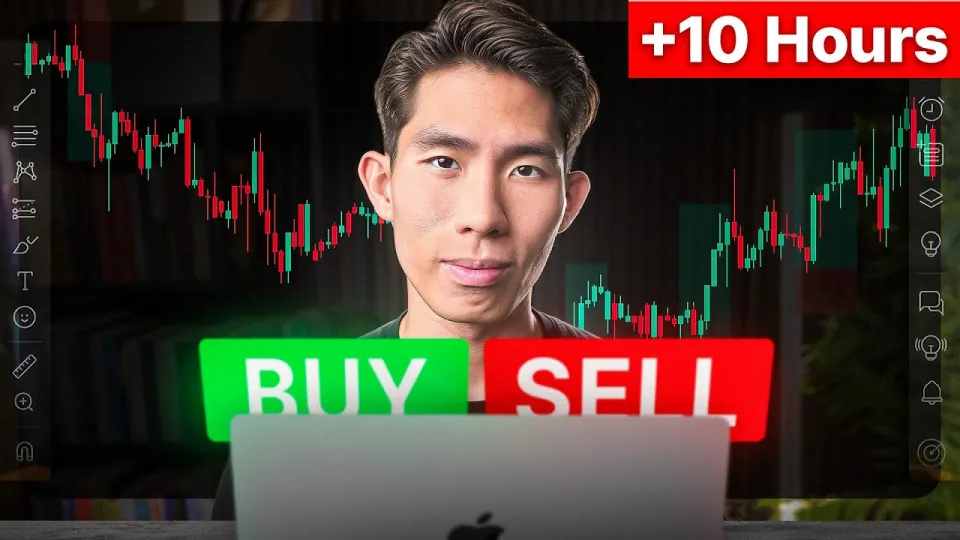
Video: How to Start Day Trading in 2026 (Full 10-Hour BEGINNER Course)
Want articles like this for your own video to promote it on YouTube and Google? Order them through the Telegram bot @sat_sit_bot. Articles with your video embedded are written and posted by the bot itself — on popular topical sites (no ads). Try it free: 50 articles on us.
· based on the channel Brad Goh (The Trading Geek)
Key takeaways
- A 10-hour beginner course from Brad Goh (The Trading Geek) covers forex basics, market structure, SMC concepts, risk management and mindset.
- The course is split into four chapters: foundations, technical analysis, mechanical strategies and psychology.
- Core concepts taught include market structure, supply and demand, flip zones, order blocks, inducements, liquidity and order flow.
- Strategies shown include a 3-step framework, a sniper entry model, 1-minute scalping and a simplified trade plan.
- The author's own path included losing over $10,000 and blowing 7 accounts before becoming consistent.
Trading is best started with a structured, free education and a written mechanical plan rather than paid signals, because the skill that decides survival is risk control, not prediction. A full beginner course that walks from forex basics to market structure, entries and psychology gives a new trader the sequence that signals never provide. Brad Goh (The Trading Geek) published exactly such a course, and his paid mentorship, The 1% Club, is available through the 1% Club mentorship page for traders who want coaching on top of the free material.
What a beginner trading course should actually contain
A useful beginner trading course moves from mechanics to analysis to execution to psychology, in that order, and each stage must be usable on its own. The 10-hour course follows four chapters: foundations of forex trading, technical analysis built on smart money concepts and market mechanics, proven mechanical strategies, and a mindset chapter. The first chapter alone covers how the forex market works, which tools a trader needs, how a $10,000-per-month target can be modelled, and how to write a mechanical trade plan. That last item matters most: a plan converts opinions into rules you can test and repeat.
The tools and account math before the first trade
Before any chart analysis, a trader needs a broker, a charting platform, a journal and a position-size calculator, and the account math must be settled first. Position sizing ties every trade to a fixed percentage of the account, so a stop-loss in pips translates into a lot size instead of a guess. The course treats risk management as a dedicated block rather than a footnote, which is the correct order: a strategy with a positive edge still fails if a single loss can remove a large share of the account. Traders who ask how much capital is required usually discover the answer depends on the instrument, the stop distance and the risk percentage per trade, not on a universal minimum.
Market structure, liquidity and the smart money toolkit
The technical half of the course is built on market structure: identifying swings, trends and shifts across multiple timeframes before looking for entries. From there it adds institutional supply and demand zones, flip zones where old support becomes resistance, order blocks, inducements that trap early entries, liquidity concepts such as sweeps of obvious highs and lows, and order flow. These are the components of the smart money concepts approach, sometimes labelled SMC or ICT, and they are descriptive tools for reading where resting orders sit. Multi-timeframe structure is taught separately because a setup on a lower timeframe only has weight when it aligns with the higher-timeframe context.
Three mechanical strategies and how they differ
The strategy chapter presents a 3-step framework, a sniper entry model, a 1-minute scalping approach and a simplified trade plan, and the differences between them are mainly timeframe and patience. The 3-step framework filters a chart down to context, zone and trigger. The sniper entry waits for a precise confirmation inside a zone rather than entering on the first touch. The 1-minute scalping model compresses the same logic into very short holding times, which raises the number of decisions per hour and the cost of hesitation. A realistic sequence for a beginner is to master the slower framework first, journal it for a few hundred trades, and only then test scalping.
Common beginner doubts about consistency and losses
Most beginner doubts are about speed of progress and the fear of losing money, and both are answered by process rather than by a better indicator. Viewers of the course repeatedly describe trying support-and-resistance or paid signals for months without results, then rebuilding their understanding around structure and risk. Others describe losing several hundred dollars in a single session and returning to study instead of quitting, which is the healthier response. A ten-hour course compresses years of material, but compression is not the same as mastery: the knowledge arrives in a day, while the discipline to apply it takes months of journaling and review.
The mindset and routine that hold the system together
The final chapter treats trading as a job with a schedule, a daily routine and defined working hours rather than as a hobby fitted around moods. It covers a funded-account blueprint, sustained focus during long sessions, and the habits that separate traders who scale from those who restart. The author's own record is part of the lesson: he lost more than $10,000 and blew 7 accounts before turning consistent, then reached his first $1 million before turning 21. That timeline is a reminder that the drawdown phase is normal and that journaling every mistake is what shortens it.
Useful links
- The 1% Club mentorship — application page for the paid programme with lessons and live coaching.
- 1% Club main site — programme overview and community access.
- EdgeFlo — the all-in-one trading platform for execution, journaling and risk management.
- Recommended broker — broker link shared by the channel.
- Recommended prop firm — funded-account challenge partner.
Final thoughts on starting trading the right way
Starting trading works best as an education-first project: learn the mechanics, write a mechanical plan, size every position by risk, and journal the results before increasing capital. The free 10-hour course by Brad Goh (The Trading Geek) is a practical spine for that project because it connects foundations, market structure, entries and psychology in one sequence. Anyone who wants structured coaching and live review after finishing the free material can apply through the 1% Club mentorship page. Treat the first months as tuition, not as income, and the numbers have time to work in your favour.
Source: How to Start Day Trading in 2026 (Full 10-Hour BEGINNER Course) · Markdown version
Questions & answers
How much money do I need to start day trading?
There is no universal minimum, because the required capital depends on the instrument, the stop-loss distance and the risk percentage you accept per trade. What matters is that a single loss stays a small fraction of the account, so a smaller account simply means smaller position sizes. Many beginners start on a demo account or a funded challenge to prove the process before risking real capital.
Is a 10-hour free course enough to become profitable?
It is enough to learn the vocabulary and the structure of a complete system, but not enough to build the discipline that makes it work. Watching compresses years of material into a day; applying it requires journaling trades, reviewing mistakes and repeating setups over hundreds of samples. Expect the learning phase to be measured in months, not hours.
What are smart money concepts and do they work for beginners?
Smart money concepts describe price action through market structure, supply and demand zones, order blocks, liquidity sweeps and inducements. They are a way of reading where stop-losses and pending orders cluster, not a guarantee of direction. For beginners they are useful because they force a top-down, multi-timeframe process instead of random entries.
Why do so many new traders lose money at the start?
Most early losses come from position sizing and impatience rather than from a lack of indicators: oversized trades, no written plan, and entering before confirmation. The author of the course describes losing over $10,000 and blowing 7 accounts before becoming consistent. A fixed risk per trade and a journal turn those losses into data instead of a reason to quit.